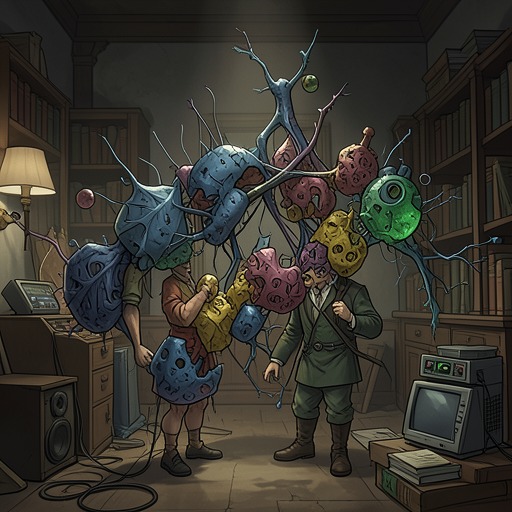
Copier
The Selfish GeneThe Replicator is the book’s hypothetical first self-copying molecule and the prototype for the replicators that drive evolution. Its emergence turns a chemically varied primeval soup into a population with lineages, competition, and cumulative change. The concept also supplies the book’s wider evolutionary principle: genes are Earth’s prevailing replicators, but any entity capable of making copies can, under the right conditions, become the basis of a new evolution.
Emergence and copying
The Replicator is imagined to have formed by accident in the ancient seas, after simpler organic substances had concentrated and combined into larger molecules. Its defining property was not size or complexity, but the ability to produce copies of itself. The event is presented as exceedingly improbable on a human timescale, yet plausible across hundreds of millions of years: the relevant measure is not the odds of a single lifetime, but the time available for rare events to occur.
The proposed mechanism is templating. A large molecule made from a sequence of building blocks could attract matching units from the surrounding soup. Once assembled into a chain, these units might separate from the original and continue copying. Alternatively, the template could produce a complementary negative, which in turn could reproduce the original positive. The precise first mechanism is left open; the crucial change is that copying made a particular molecular arrangement reproducible rather than a temporary accident.
This distinction created a new kind of stability. Before replication, complex molecules depended on building blocks happening to fall into a stable configuration and were unlikely to become abundant. Once a replicator existed, its copies could spread through the seas, using up small building blocks and making other large molecules comparatively rare. The Replicator’s importance therefore lay not merely in its own persistence, but in the way its copying altered the conditions in which other molecular forms could exist.
Variation, competition, and selection
Copying was not perfect. Errors passed into later copies and accumulated across generations, so the population did not remain a set of identical replicas. It became a collection of varieties descended from a common ancestor. In the book’s account, this imperfection is not simply damage: some copying errors can improve a replicator’s prospects and make evolutionary change possible.
Varieties differed in longevity, or how long they remained intact; fecundity, or how quickly they made copies; and copying accuracy. Greater longevity gave a molecule more time to reproduce, while faster replication could outweigh a longer life in a rival type. More accurate copying also helped a lineage retain its successful characteristics, since errors could cost not only the immediate copy but its potential descendants. These qualities affected relative abundance, not through foresight or intention, but through the differential persistence and multiplication of copies.
Growth in replicator numbers brought competition. The primeval soup could not supply an unlimited number of molecules: the Earth was finite, and the small building blocks required for copying became scarce as replicators consumed them. Less successful varieties consequently declined, and many lineages disappeared. The struggle had no conscious participants; it consisted of differences in which molecular forms survived and left copies.
Some variations may have enabled replicators to break down rival molecules and use their released building blocks, at once gaining material and removing competitors. Others may have helped a replicator defend itself chemically or enclose itself in a protein wall. In this gradual contest, means of exploiting rivals and means of protection could accumulate and grow more elaborate. The proposed first living cells arise within this account as one possible result of replicators acquiring protective containers.
From replicators to survival machines
The protective coat was only the beginning of a longer transformation. As new rivals arose with more effective means of survival, the structures built around replicators became larger and more elaborate. Replicators no longer existed simply as exposed molecules in the sea: they constructed vehicles that helped them persist and reproduce. The book calls these vehicles survival machines, emphasizing that the structures are consequences of replicators’ continued success rather than independent replicating lineages.
The account follows this development across roughly four billion years. The ancient replicators did not vanish; they became genes, gathered in enormous colonies inside complex organisms. Their former freedom in the sea gave way to life within bodies, while their effects on the outside world came to be mediated through those bodies. The book’s compressed formulation is that genes are the replicators and organisms are their survival machines.
That formulation does not mean that a body is controlled by one gene acting alone. Modern survival machines contain thousands of genes whose effects interact: one gene may influence many parts of a body, and any body part may be shaped by many genes and the environment. Genes can be treated as distinct replicators because sexual reproduction shuffles their combinations between generations; an individual body is a temporary vehicle, while a gene may persist through a succession of different bodies. The Replicator thus connects the book’s account of life’s origin to its gene-centered explanation of inheritance and selection.
The replicator as a general principle
The book treats the gene not as the only imaginable replicator, but as the replicating entity that prevails on Earth. Its larger proposed principle is that life evolves through the differential survival of entities that make copies. The argument is deliberately open to unfamiliar possibilities: life elsewhere might have chemistry based on silicon or ammonia, or even depend on electronic circuits rather than chemistry. Whatever its material basis, a form of life could evolve if it included entities that replicate and if their descendants differed in their capacity to do so.
The same principle is used to introduce cultural replication. Human genes helped create brains and therefore the conditions in which memes could arise, but the book argues that this new copying process need not remain subordinate to genetic evolution. Memes spread through imitation from brain to brain; their success, like that of genes, depends on properties such as fecundity and copying fidelity. This extension makes the Replicator a general explanatory category rather than a name limited to the first molecule or to DNA.
In the closing account, replicators appear first, arising by chance from the random jostling of smaller particles. Copying errors then produce varieties: some lose the ability to replicate, some reproduce less effectively, and others acquire traits that let their descendants dominate. Their consequences can be indirect. A replicator’s effect on the world matters when it eventually feeds back into the success of its copies, whether that effect occurs through a body, an object, or another living being.
Replicators also shape one another’s prospects. Compatible forms can become common in each other’s presence, and their association can be formalized in discrete vehicles, first cells and later multicellular bodies. Bottlenecked life cycles and discrete organisms reinforce one another, further consolidating replicators within bodies. Yet this packaging is not presented as a requirement for life everywhere: the individual body is a consequential arrangement, not the fundamental prerequisite. The book ends by locating that prerequisite in the immortal replicator—the entity whose copies, variations, and unequal success make evolution possible.